The Heart
Your heart has 4 chambers; two on the top called the atria and two on the bottom which are the ventricles. Similar to your house, your heart has an electrical system as well as plumbing. Atrial fibrillation is a heart rhythm and the rhythm of your heart falls under the roof of its electrical system. The study and treatment of this domain is cardiac electrophysiology. So, for the purpose of discussing and understanding Afib (atrial fibrillation), we turn our attention to the heart’s electrical system and the electricians (doctors, specifically electrophysiologists) that service (treat) it.
Chaotic Atrial Signals + Inconsistent Ventricular Responses = An Irregularly Irregular Heartbeat
First let’s talk conceptually.
Atrial fibrillation is an irregularly irregular heart rhythm. Yes, irregularly irregular, meaning that not even the irregularity of the rhythm is predictable. There is no pattern, in simple terms it is just all over the place. Hectic, disorderly and chaotic.
In normal sinus rhythm, the atria are good leaders so to speak. They are reliable and consistent. Their contractions rhythmically precede those of the ventricles with predictability. Simply, the sinus node sends a single, the atria respond by contracting and the ventricles then follow suit.
In atrial fibrillation the leadership skills of the atria falter. Signals fire all over the place, they become erratic and the atria “quiver” or “fibrillate” rather than contract. The ventricles are flooded with signals and confusion, they try to keep up but they can not successfully make sense of and follow the chaos. Imagine an orchestra trying to follow 100 different conductors, pulled in many directions and overwhelmed by signals, the orchestra would produce an erratic rhythm just like Afib!
“What are those squiggly lines?”
Now let’s talk in terms of those infamous squiggly lines your doctor reads.
An EKG or an electrocardiogram reflects the electrical activity of your heart. It maps the activity that takes place in the atria (the top two chambers of your heart) as well as the ventricles (the bottom two chambers). The heart’s electrical system can feel a bit like a black box, meaning, something is certainly going on in there but we can’t actively see it. An EKG gives us a window and captures the electrical activity in a way that can be visualized.
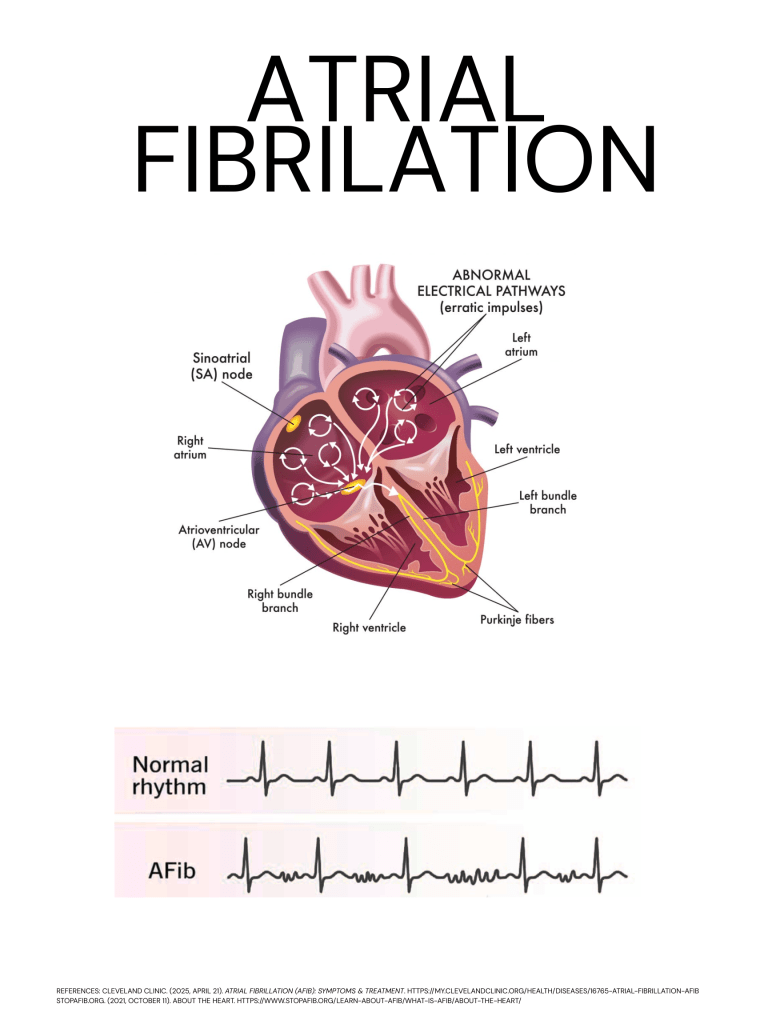
This infographic incorporates two visualization to help clarify these concepts through an EKG as well as a diagram. Both images highlight dysfunction in the heart related to atrial fibrillation. The strip labeled “Normal Rhythm” shows just that, typical, regular atrial and ventricular electrical activity. For our purposes, in this instance, the key is the presence of erratic squiggles between the larger peaks on the second strip labeled “AFib” (white arrows point to these areas). Those squiggly lines represent the chaos of the atrial activity during AFib.
AFib may be chaotic but learning to understand it doesn’t have to be!
References
Cleveland Clinic. (2025, April 21). Atrial fibrillation (AFib): Symptoms & treatment. https://my.clevelandclinic.org/health/diseases/16765-atrial-fibrillation-afib
 ccadorette56c776821a-rjgmi
Leave a comment